
Παρουσίαση/Προβολή
ΕΠΙΣΤΗΜΟΝΙΚΗ ΟΡΟΛΟΓΙΑ ΣΤΑ ΑΓΓΛΙΚΑ 2026+
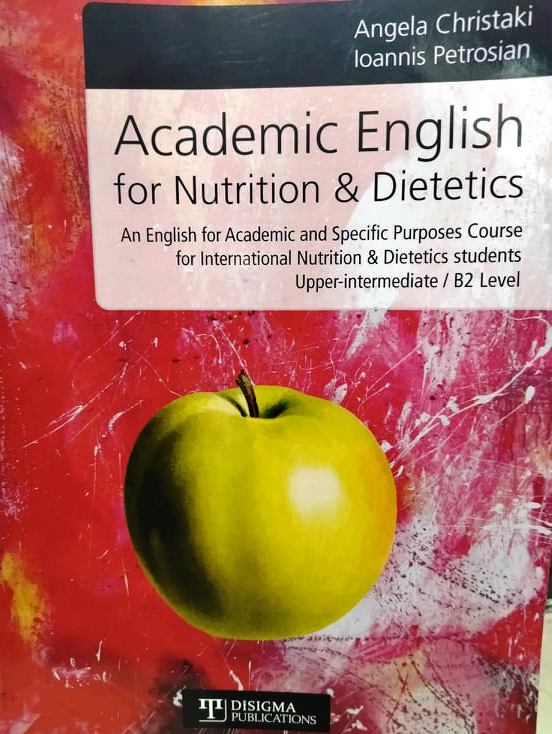
(NDS207) - Angela Christaki
Περιγραφή Μαθήματος
Α syllabus for the teaching of English for Specific Purposes (ESP) and English for Academic Purposes (EAP) in the field of Nutrition & Dietetics and Food Technology. Along with the use of content specific language and acquisition of subject specific vocabulary, students will practice their receptive (reading & listening) and productive (speaking & writing) skills.
CONTENTS
Chapter 1 “Nutrients on Food Labels”
Themes: Micronutrients, macronutrients, nutrients of public health concern, dietary guidelines for Americans, carbohydrates, fats, vitamins, minerals, water, food labels
Academic Reading Skills: Selecting, Skimming, Scanning
Academic Presentation Skills: Making effective presentations
Academic Speaking Skills: Making a presentation using your notes
Academic Note-taking Skills: Taking notes from a text to use in a presentation (abbreviations & symbols),
Interaction Skills: Exchanging ideas with peers to reach a common decision
Chapter 2 “Food Groups”
Themes: Food group properties, dietary pattern, nutrient-dense foods, “My Plate”, food safety recommendations
Academic Speaking Skills: Describing a process
Note-taking Practice: Taking notes from a talk on “Choose my Plate”
Academic Vocabulary Skills: Weights & Measurements
Academic Writing Skills: Paragraph Writing
Chapter 3 “Human Anatomy”
Themes: Integumentary, skeletal, muscular, cardiovascular, nervous, endocrine, lymphatic, respiratory, digestive, urinary, reproductive systems; their organs and function
Academic Writing Skills: Parallelism, Coherence & Cohesion, Subject-Verb Agreement
Academic Vocabulary Skills: Latin/Greek Plural, Formation of Medical terms
Note-taking Practice: Note-taking from a video about the immune system of the human body
Communication Skills: Exchanging ideas with peers about how the immune system works
Chapter 4 “Digestive system & Endocrine system”
Themes: Ingestion, digestion, alimentary canal, problems during digestion, endocrine glands, exocrine glands, homeostasis, organs of the two systems
Academic Speaking & Writing Skills : Describing Charts & Diagrams
Note-taking Practice: Note-taking from a video about the systems of the human body
Academic Interaction Skills: Exchanging information by asking and answering Wh-questions
Academic Writing Skills: Using defining and non defining clauses
Chapter 5 Nutrition through the Life Cycle: Nutrition during Pregnancy & Lactation
Themes: Maternal body size, maternal weight gain, primigravida, multigravida,
maternal underweight, morbidity, birth weight, Apgar score, aversions, cravings
Pica, hindmilk, foremilk, neural tube defects, weaning,
Academic Listening Skills: Listening to a 3΄ talk
Note-taking Practice: Taking notes from a text, to use in a 3΄talk
Academic Speaking Skills: Making a 3΄talk using your notes
Academic Writing Skills: Avoiding repetition, expressing cause & effect
Chapter 6 Nutrition through the Life Cycle: Child and Adolescent Nutrition - Childhood Obesity
Themes: Formula milk, solid food, food intolerance, commercial baby foods, eating patterns, toddlers, cognitively, fine motor skills, childhood obesity, puberty, sexual maturation rate, peer acceptance, fad diets, anabolic steroids
Academic Vocabulary Skills: Collocations
Academic Listening Skills: Listening to fill in a table
Academic Speaking Skills :Interaction (role-play), changing roles
Academic Writing & Speaking Skills: Expressing Ability and Possibility
Chapter 7 Nutrition through the Life Cycle: Adult Nutrition & Nutrition for the Elderly
Themes: Maturation, cardiac functioning, primary and secondary aging, reproductive capacity, menopause, mood swings, weight management, muscle agility, fractures, diverticular disease, sarcopenia.
Academic Writing Skills: Writing a lab report, using verbs of Reference
Academic Listening & Note-taking Skills: Watching a video and taking notes
Critical Thinking: Tracing the differences Compare the “Choose my plate for adults” with the “My plate for Older Adults”.
Interaction Skills: Discussing with peers to reach a common decision
Chapter 8 Eating Disorders
Themes: Anorexia nervosa, bulimia nervosa, binge eating disorder, PICA, rumination disorder, avoidant/restrictive food intake disorder, night eating syndrome, drunkorexia, orthorexia, other specified feeding or eating disorder (OSFED).
Academic Writing Skills: Avoiding wordiness, writing a conclusion
Interaction skills: Expressing agreement – disagreement
Speaking Skills: Giving advice
Chapter 9 Nutrition and Health Claims –– Food Additives
Themes: Regulation, nutrition claims, health claims, fair competition, authorisation, transparency, legislation, regulations, food additives, toxicity, carcinogenicity, genotoxicity, emulsifiers, irradiation, pasteurisation, inhibition, inactivation, recontamination, sustainability, hygienic processing, interactive indicators, intelligent/active packaging
Academic Writing Skills: Abstract Writing
Interaction Skills: Discussing with peers
Critical thinking: Thinking implications and analysing pros and cons
Academic Speaking Skills: Making a Speech
Chapter 10 Body Composition – Sports Nutrition – Clinical Nutrition
Themes: Essential fat, metabolic disorders, dual energy X-ray absorptiometry (DEXA), underwater weighing (UWW), skin-fold thickness (SFT), body mass index (BMI), bioelectrical impedance analysis (BIA), isotope dilution (ID), non-invasive, lean body/ adipose tissue, electrical impedance, intermittent/ high-intensity, chronic endurance, endogenous fat
Academic writing: Paraphrasing, summarizing
Ημερομηνία δημιουργίας
Sunday, March 6, 2022
-
Περίγραμμα
Δεν υπάρχει περίγραμμα